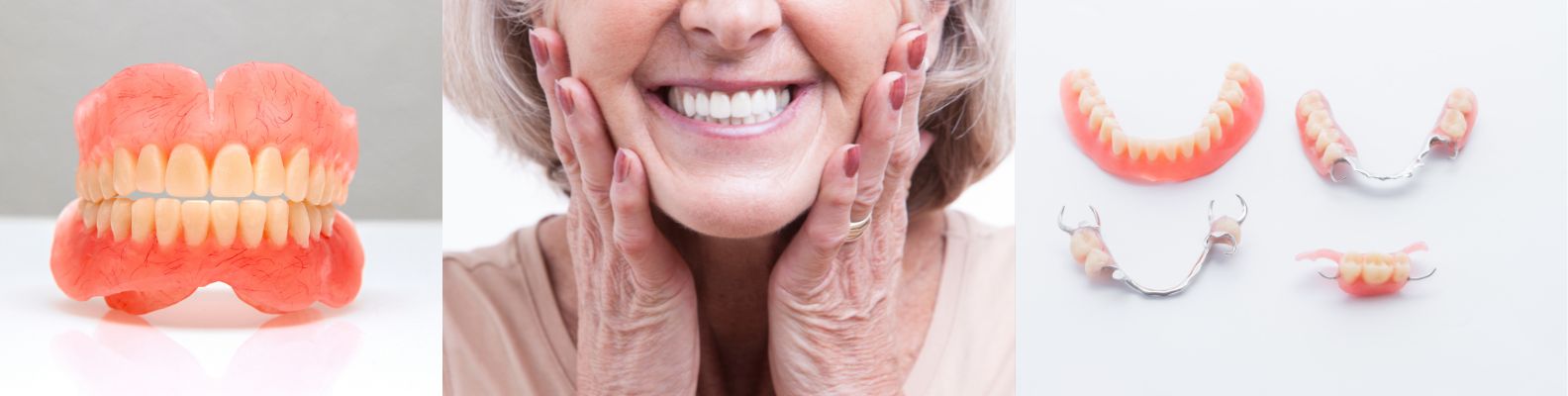
Who Needs Dentures?
Dentures are removable replacement teeth for people who have lost some or all of their natural teeth due to decay, gum disease or injury. A complete denture replaces all the teeth in the upper or lower jaw, while a partial denture fills gaps when some healthy natural teeth remain. Replacing missing teeth helps you chew and speak properly, supports your cheeks and lips, and stops the remaining teeth from drifting into the gaps.
How Dentures Are Made
- Examination: the dentist checks your gums, remaining teeth and jawbone, and discusses which type of denture suits you.
- Impressions and measurements: precise moulds of your mouth and bite records are taken.
- Trial fitting: a trial denture is checked for fit, bite, appearance and tooth shade before the final one is made.
- Final fitting and adjustments: the finished denture is fitted, and small adjustments are made at follow-up visits for comfort.
Conventional Dentures vs Implant-Supported Dentures
Conventional dentures rest on the gums and are held in place by suction or clasps. Implant-supported dentures attach to dental implants placed in the jawbone, which makes them much more stable, improves chewing and helps reduce bone loss. If loose dentures are a problem, ask our dentist whether you are suitable for implant-supported dentures.
Caring for Your Dentures
- Remove and rinse your dentures after meals.
- Clean them daily with a soft denture brush and a non-abrasive cleanser rather than regular toothpaste.
- Remove them at night, unless advised otherwise, to let your gums rest, and keep them in water or a denture-soaking solution so they do not dry out.
- Handle them over a folded towel or a basin of water so they do not break if dropped.
- Visit the dentist regularly so the fit can be checked as your gums change over time.
Frequently Asked Questions
How long does it take to get used to new dentures?
Most people take a few weeks to get used to new dentures. It is normal to feel some extra saliva, minor soreness or difficulty with certain words at first. Starting with soft foods and practising speaking aloud helps, and the dentist can adjust any sore spots.
Can I eat normally with dentures?
Yes, with practice. Start with soft foods cut into small pieces and chew on both sides at the same time. Over time you can return to most foods, but very hard or sticky foods are best avoided.
How long do dentures last?
Dentures usually last several years with good care. Because the gums and jawbone gradually change shape, dentures may need relining, adjustment or replacement over time to keep them fitting well.
Should I sleep with my dentures in?
In most cases, dentures should be removed at night to give your gums time to rest and to keep your mouth healthy. Your dentist will advise you if your situation is different.
What is the difference between flexible and acrylic dentures?
Flexible partial dentures are made from a thin, bendable material that is comfortable and has no visible metal clasps. Traditional acrylic dentures, sometimes with a metal framework, are rigid and strong. Your dentist will recommend the best option based on your remaining teeth and gums.
How much do dentures cost in Gurgaon?
The cost of dentures depends on the type of denture, whether it is partial or complete, the materials used, and whether it is supported by implants. You will receive a clear estimate after your examination at our clinic.
Medically reviewed by Dr. Ankur Gupta, BDS, MDS (Orthodontics) | Haryana Dental Council 1378A – Reg | 📅 Last medically reviewed: 27 October 2026