

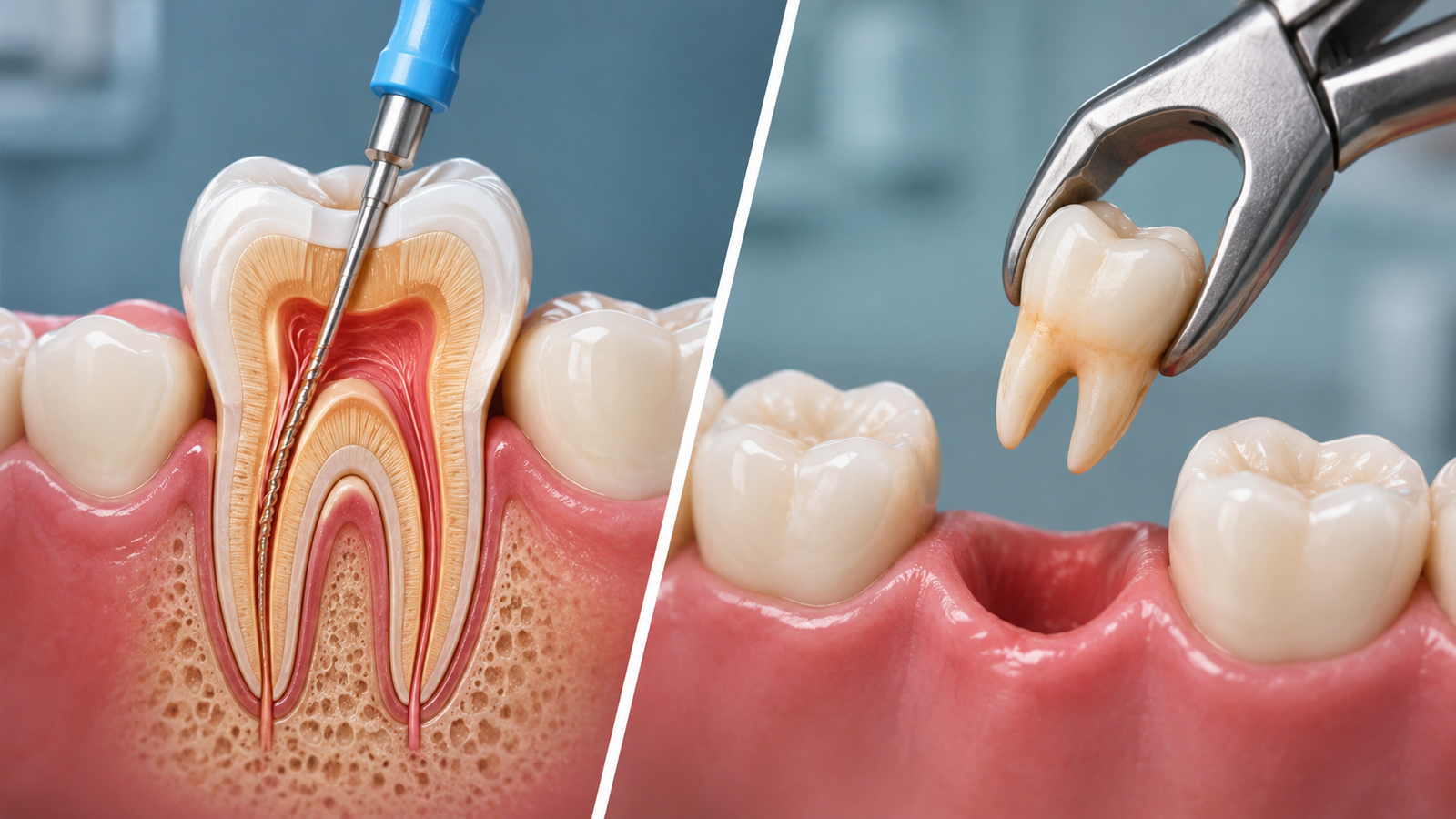
Tooth pain can be more than just uncomfortable. A persistent toothache, sensitivity to hot or cold foods, swelling, or pain while chewing may indicate that a tooth has developed a deeper problem. When the damage reaches the inner pulp of the tooth, your dentist may recommend either a root canal treatment or tooth extraction.
But which option is better? Should you save your natural tooth with a root canal, or remove it and consider a replacement?
The answer depends on the extent of tooth damage, the condition of the surrounding gums and bone, your overall oral health, and whether the tooth can be restored successfully.
At Dr. Gupta’s Dental Implant and Orthodontic Centre, understanding your treatment options can help you make an informed decision about your dental health. This guide explains the difference between root canal treatment and tooth extraction, their benefits, risks, costs to consider, and when each procedure may be recommended.
What Is Root Canal Treatment?
Root canal treatment, also known as RCT or endodontic treatment, is a procedure used to treat infection or inflammation inside a tooth. The inner part of the tooth, called the pulp, contains nerves, blood vessels, and connective tissue.
When the pulp becomes infected due to deep cavities, trauma, cracks, or repeated dental procedures, it may cause significant pain and sensitivity. A root canal helps remove the infected tissue while preserving the outer structure of the natural tooth.
How is root canal treatment performed?
A typical root canal procedure involves the following steps:
- Dental examination: The dentist examines the tooth, symptoms, and dental X-rays to understand the extent of infection or damage.
- Local anaesthesia: The affected area is numbed to make the procedure comfortable.
- Removal of infected pulp: The infected or inflamed pulp tissue is removed from inside the tooth.
- Cleaning and disinfection: The root canals are cleaned, shaped, and disinfected to reduce bacteria.
- Sealing the tooth: The canals are filled with a suitable material and sealed.
- Final restoration: Depending on the remaining tooth structure, a filling or dental crown may be recommended to protect the treated tooth.
A root canal may often be completed in one or more appointments, depending on the complexity of the tooth and the infection.
What Is Tooth Extraction?
Tooth extraction is a dental procedure in which a tooth is removed from its socket in the jawbone. It may be recommended when a tooth is severely damaged, infected, loose, or cannot be restored with predictable results.
Depending on the condition of the tooth, the dentist may perform a simple extraction or a surgical extraction.
When is tooth extraction recommended?
A dentist may recommend removing a tooth in situations such as:
- Severe tooth decay that has destroyed too much tooth structure
- A fractured tooth or root that cannot be restored
- Advanced gum disease causing significant tooth mobility
- Infection that cannot be managed with appropriate tooth-saving treatment
- Certain impacted teeth
- A tooth with an unfavourable prognosis after previous treatment
Removing a tooth may resolve the problem in the affected area, but the decision should also consider what happens to the space afterward. Missing teeth can affect chewing, bite alignment, and neighbouring teeth. In many cases, a replacement option such as a dental implant, bridge, or denture may need to be discussed.
Root Canal vs Tooth Extraction: Key Differences
Understanding the difference between root canal treatment and extraction can help you discuss the right treatment with your dentist.
| Factor | Root Canal Treatment | Tooth Extraction |
| Main purpose | Treat infection and preserve the natural tooth | Remove a damaged or unsalvageable tooth |
| Natural tooth | Retained | Removed |
| Procedure | Cleaning, disinfecting and sealing root canals | Removing the tooth from its socket |
| Recovery | Mild tenderness may occur | Healing of the extraction socket is required |
| Chewing function | Maintained after proper restoration | May be affected if the tooth is not replaced |
| Additional treatment | May require a crown or filling | May require implant, bridge, or denture |
| Long-term impact | Helps preserve natural tooth function | Missing-tooth space may affect bite and neighbouring teeth |
| Suitable for | Teeth that can be treated and restored | Teeth with poor or non-restorable prognosis |
The choice is not simply about which procedure is quicker. It is about which treatment offers the best long-term outcome for your oral health.
Root Canal vs Tooth Extraction: Which Is Better?
In many cases, root canal treatment is preferred when the natural tooth can be successfully treated and restored. Preserving your natural tooth helps maintain normal chewing function, bite alignment, and the natural relationship between your teeth.
However, a root canal is not suitable for every tooth. If the damage is extensive or the tooth cannot be restored, extraction may be the safer and more predictable option.
Why root canal treatment may be the better option
Saving your natural tooth offers several advantages:
- Preserves your natural smile: You retain your own tooth instead of replacing it with an artificial one.
- Maintains chewing function: A restored natural tooth can continue to help you bite and chew normally.
- Helps maintain tooth alignment: Keeping the tooth in place reduces the risk of neighbouring teeth drifting into the gap.
- Avoids immediate tooth replacement: You may not need an implant, bridge, or removable denture to replace the tooth.
- May reduce overall treatment expenses: When the tooth is restorable, saving it may avoid the additional cost of extraction and replacement.
- Supports long-term oral health: Retaining a functional tooth can help maintain your natural bite and surrounding dental structures.
A root canal does not make a tooth indestructible. The tooth may need a crown for protection, and good oral hygiene and regular dental check-ups remain important.
Whenever a tooth can be predictably saved, preserving it is generally worth considering.
When Is Tooth Extraction the Better Choice?
Although preserving natural teeth is often a priority, extraction may be recommended if keeping the tooth is unlikely to provide a healthy or stable result.
Tooth extraction may be the more appropriate treatment when:
1. The tooth is severely damaged
If decay or a fracture has destroyed most of the tooth structure, there may not be enough healthy tooth left to support a filling or crown.
2. The tooth has a deep fracture
Some fractures extend below the gumline or involve the root. In these cases, a root canal may not solve the structural problem.
3. There is advanced periodontal disease
Severe gum disease can damage the supporting bone and tissues. Even if the tooth’s pulp can be treated, poor support may make the tooth unstable.
4. The tooth cannot be restored predictably
A dentist may determine that the tooth cannot be rebuilt in a way that provides reliable function and long-term stability.
5. Previous treatment has failed
Sometimes a tooth may not heal as expected after previous root canal treatment. Retreatment or endodontic surgery may be considered in selected cases, but extraction may be appropriate if the prognosis remains poor.
The decision should be based on clinical examination, dental imaging, the tooth’s restorability, and the patient’s needs rather than a one-size-fits-all recommendation.
Is Root Canal Treatment More Painful Than Tooth Extraction?
Many people fear root canal treatment because of stories they have heard about dental pain. In reality, modern root canal treatment is performed using local anaesthesia, which helps minimise pain during the procedure.
The pain often comes from the infection or inflammation that existed before treatment, rather than from the root canal procedure itself.
Pain during root canal treatment
With appropriate anaesthesia, most patients experience pressure or vibration rather than sharp pain. Some tenderness may occur after treatment, particularly if the surrounding tissues were inflamed.
Pain during tooth extraction
Tooth extraction is also performed under local anaesthesia. Patients may feel pressure during removal, followed by soreness, swelling, and discomfort as the extraction site heals.
The recovery experience varies depending on the tooth, infection, procedure complexity, and individual healing.
If you are worried about dental pain, discuss your concerns with the dentist before treatment. They can explain the procedure, pain-management options, and what to expect afterward.
Root Canal vs Extraction: Which Is More Cost-Effective?
Cost is an important consideration for many patients, but it is helpful to compare the complete treatment plan rather than just the initial procedure.
Cost of root canal treatment
The total cost may include:
- Dental consultation and X-rays
- Root canal procedure
- Temporary filling, if required
- Permanent restoration
- Dental crown, if recommended
Cost of tooth extraction
The total cost may include:
- Consultation and imaging
- Tooth extraction
- Follow-up appointments
- Bone grafting, if required
- Dental implant, bridge, or denture
- Final restoration
Extraction may initially seem less expensive because the tooth is removed in one procedure. However, replacing the missing tooth can involve additional treatment and expenses.
If the tooth can be restored successfully, Root Canal Treatment In Gurgaon may be a practical long-term option for maintaining your natural tooth while avoiding replacement procedures.
Actual treatment costs vary depending on the tooth, complexity, materials used, and the treatment plan recommended by the dentist.
What Happens If You Extract a Tooth and Do Not Replace It?
Removing a tooth without replacing it may not cause immediate problems in every patient, but it can create changes over time.
Potential consequences include:
- Shifting of neighbouring teeth: Adjacent teeth may gradually move into the empty space.
- Changes in bite alignment: The way your upper and lower teeth meet may change.
- Difficulty chewing: Missing teeth can make it harder to chew certain foods comfortably.
- Changes in opposing teeth: The tooth opposite the missing tooth may gradually move into the vacant space.
- Bone changes: The jawbone in the area of a missing tooth may gradually undergo bone loss.
The effects depend on which tooth is missing, your bite, gum health, and other individual factors.
If extraction is necessary, your dentist may discuss replacement options such as a dental implant, fixed bridge, or removable partial denture.
Signs You May Need Root Canal Treatment
Certain symptoms may indicate that the pulp inside your tooth is infected or inflamed and needs professional evaluation.
Common warning signs include:
- Persistent or throbbing toothache
- Sensitivity to hot or cold that lingers
- Pain while biting or chewing
- Swelling around the gums
- A pimple-like bump on the gums
- Darkening or discolouration of the tooth
- Pain that wakes you up at night
- Bad taste or discharge around an affected tooth
Not every toothache requires a root canal. Cavities, gum problems, cracked teeth, and other conditions can cause similar symptoms. A dentist can identify the cause through examination and appropriate imaging.
If you notice swelling accompanied by fever, spreading facial swelling, difficulty swallowing, or difficulty breathing, seek urgent dental or medical care.
Root Canal Treatment In Gurgaon: Why Early Diagnosis Matters
When dental pain is ignored, a small cavity may progress into a deeper infection. Early diagnosis can help identify the problem before more extensive treatment becomes necessary.
If you are searching for Root Canal Treatment In Gurgaon, consider choosing a dental clinic that:
- Performs a thorough examination before recommending treatment
- Explains whether the tooth is restorable
- Uses appropriate dental imaging
- Discusses treatment alternatives and their benefits and risks
- Explains the need for a crown or other restoration
- Provides clear post-treatment instructions
- Encourages follow-up care and preventive dental visits
At Dr. Gupta’s Dental Implant and Orthodontic Centre, patients can seek dental evaluation to understand whether a damaged tooth can be saved or whether extraction and replacement may be more appropriate.
The goal of dental treatment should be to relieve pain, control infection, restore function, and protect long-term oral health.
How to Care for Your Tooth After Root Canal Treatment
Proper aftercare helps protect the treated tooth and support healing.
Follow your dentist’s instructions
Take prescribed medications as directed and attend any recommended follow-up visits.
Avoid chewing hard foods on the treated tooth
Until the tooth receives its permanent restoration, avoid biting hard foods directly on it. A tooth that has undergone root canal treatment may be more vulnerable to fracture, particularly if substantial tooth structure has been lost.
Maintain good oral hygiene
Brush twice daily with fluoride toothpaste and clean between your teeth regularly. Keeping the surrounding gums healthy is essential.
Complete the recommended restoration
If your dentist recommends a crown, do not unnecessarily delay it. A crown or other restoration may help protect the tooth from fractures and restore normal function.
Schedule regular dental check-ups
Regular dental visits allow your dentist to monitor healing, check the restoration, and identify any new dental problems early.
How to Care for Your Tooth After Extraction
After tooth extraction, follow your dentist’s instructions carefully to help the socket heal.
- Bite on gauze as instructed to control bleeding.
- Avoid vigorous rinsing or spitting during the initial healing period.
- Avoid smoking, as it can interfere with healing.
- Eat soft foods while the extraction site is tender.
- Keep your mouth clean while avoiding direct trauma to the socket.
- Take prescribed medication according to instructions.
- Attend follow-up appointments if recommended.
Your dentist will also discuss when and whether the extracted tooth should be replaced.
Frequently Asked Questions (FAQs)
1. Is a root canal better than tooth extraction?
If the tooth can be successfully treated and restored, root canal treatment is often preferred because it preserves your natural tooth, chewing function, and alignment. Extraction may be necessary when the tooth cannot be saved.
2. Can I avoid a root canal by getting the tooth removed?
Yes, extraction may remove the affected tooth, but it does not automatically eliminate the need for further dental treatment. Depending on the location of the missing tooth, you may need an implant, bridge, or denture to restore chewing function and maintain your bite.
3. Is root canal treatment painful?
Root canal treatment is performed under local anaesthesia to minimise discomfort. You may experience mild soreness or tenderness afterward, but the procedure is generally manageable for most patients.
4. How long does a root canal-treated tooth last?
A root canal-treated tooth can last many years and sometimes a lifetime with proper restoration, regular dental check-ups, and good oral hygiene. Its longevity depends on the remaining tooth structure, restoration quality, bite forces, and overall oral health.
5. Can an infected tooth be saved?
Many infected teeth can be saved with root canal treatment. However, a tooth with severe structural damage, certain root fractures, or inadequate supporting tissues may not be suitable for treatment.
6. Does every root canal-treated tooth need a crown?
Not every tooth requires a crown. The decision depends on the tooth’s location, how much natural tooth structure remains, and the risk of fracture. Back teeth often need additional protection because they experience significant chewing forces.
7. What is the alternative to root canal treatment?
Depending on the diagnosis, alternatives may include extraction, tooth replacement with a dental implant, bridge, or denture. In selected cases, other pulp-preserving treatments may also be possible. Your dentist will recommend options based on the tooth’s condition.
8. Where can I get Root Canal Treatment In Gurgaon?
If you have persistent tooth pain, sensitivity, swelling, or discomfort while chewing, you can consult Dr. Gupta’s Dental Implant and Orthodontic Centre for an evaluation and personalised treatment recommendation.
Conclusion: Save Your Tooth Whenever Possible
When comparing root canal treatment vs tooth extraction, preserving your natural tooth is generally a preferred option if it can be treated and restored successfully. A root canal can help eliminate infection, relieve pain, and maintain your natural chewing function without immediately requiring tooth replacement.
However, if the tooth is severely damaged, fractured, or has poor supporting structures, extraction may be the appropriate treatment. The best choice depends on your clinical condition, not simply the procedure’s cost or convenience.
If you are experiencing tooth pain or suspect an infection, do not delay dental evaluation. Getting the right diagnosis early can help protect your oral health and reduce the risk of more complicated treatment in the future.
For professional guidance on Root Canal Treatment In Gurgaon, consult Dr. Gupta’s Dental Implant and Orthodontic Centre to understand your options and make an informed decision about your dental care.